
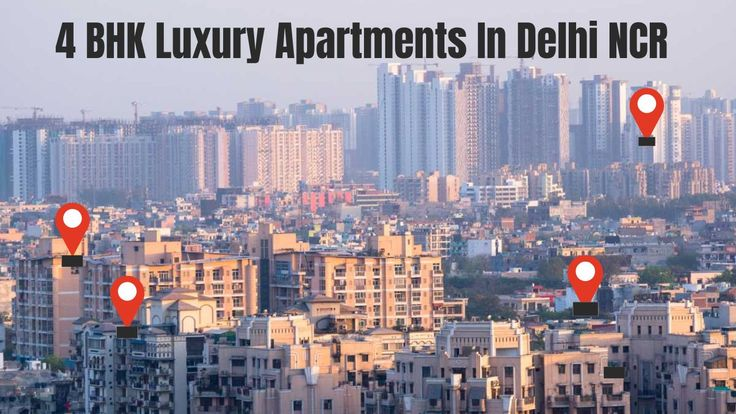
If you are looking to buy or invest in properties in Delhi NCR, you are entering one of India’s largest and most dynamic real estate markets. Spanning Gurugram, Noida, Faridabad, and Ghaziabad, this mega-region tells a story of urban ambition, policy shifts, and evolving buyer priorities.
Market overview
The market for properties in Delhi NCR has undergone a dramatic transformation over the past decade. Post-pandemic demand surges, RERA implementation, and metro network expansion have collectively reshaped how buyers, investors, and developers engage with this region.
The market bifurcated sharply: affordable housing (under ₹50 lakhs) struggled with funding and delayed delivery, while the premium and luxury segment (₹1.5 Cr+) saw record-breaking absorption, especially in Gurugram’s Golf Course Extension Road and Noida Expressway corridor.
Key themes driving the market
1. The infrastructure effect
Connectivity has been the single biggest price catalyst across properties in Delhi NCR. Localities that gained metro access within 2 km saw property appreciation of 18–28% within 24 months of line operationalization.
2. RERA’s role in restoring trust
Before RERA (2017), delayed delivery was endemic. Post-RERA, buyer confidence recovered steadily. Registered developers saw 2–3x higher conversion rates compared to unregistered ones by 2024.
3. Work-from-home and larger homes
Demand shifted decisively toward 3BHK and 4BHK configurations. The average ticket size of a first-time buyer rose from ₹55L in 2019 to ₹88L in 2025, reflecting both price appreciation and the preference for more space.
Case examples
Example 1
Gurugram’s Golf Course Extension Road boom
Between 2022 and 2025, GCER emerged as NCR’s luxury hotspot. Projects by DLF, Sobha, and M3M saw 3BHK prices climb from ₹1.8 Cr to ₹3.1 Cr. High-quality amenities, proximity to corporate hubs, and low inventory created a perfect demand storm. Resale volumes grew 40% YoY by 2024.
Example 2
Noida Expressway — the startup corridor
Sectors 150 and 137 along the Noida Expressway attracted IT workers and young professionals priced out of Gurugram. Developers like Godrej and ATS launched projects with strong sports amenities. Prices rose from ₹4,200/sq ft (2020) to ₹6,800/sq ft (2025) — a 62% jump in five years.
Example 3
Faridabad’s affordable housing challenge
Despite good road connectivity and lower prices (₹3,200–4,500/sq ft), Faridabad struggled with stalled projects and builder insolvencies. Buyers who purchased in 2016–18 waited 6–8 years for possession. This illustrates the risk asymmetry in NCR’s lower-cost segment.
Outcomes observed
- Luxury and premium segments in Gurugram and Noida Expressway delivered 15–25% annualized returns for investors who entered pre-launch between 2021–22.
- RERA compliance dramatically reduced project delays from an average of 48 months (pre-RERA) to 14 months (post-2021) in registered projects.
- NRI investment, buoyed by a favorable rupee exchange rate, contributed significantly to the ultra-luxury segment (above ₹5 Cr), particularly in Aerocity and DLF 5.
- Rental yields in NCR remain modest at 2.5–3.5% — making Delhi NCR more of a capital appreciation play than an income-generating market.
- Resale of stalled affordable housing projects caused significant financial and emotional distress for middle-income buyers, particularly in Noida extension and Bhiwadi.
“Delhi NCR rewards the informed buyer. The spread between the best and worst performing micro-markets in the same city can be as wide as 60 percentage points over five years.”
Lessons learned
- Location specificity matters more than city-level data. NCR is not one market — it is 15 micro-markets with radically different fundamentals. Never rely on city-wide averages when making a buying decision.
- Infrastructure announcements are leading indicators. Buying within 2 km of an announced metro station or expressway extension before operationalization has historically yielded the highest returns.
- Developer track record is non-negotiable. In a market prone to stalling, choosing a RERA-registered developer with a clean delivery history is the single most important risk mitigation tool for end-users.
- The affordable segment carries disproportionate risk. Lower-priced projects are more vulnerable to funding issues, builder stress, and delays. First-time buyers should factor in a realistic possession timeline buffer of 2–3 years beyond the promised date.
- NCR is a capital appreciation market, not a rental yield market. Investors expecting rental income comparable to Mumbai or Bengaluru will be disappointed. The real value proposition is long-term price appreciation in well-connected corridors.